3.15.2012

Et tu, Brute?

File:Cesar-sa mort.jpg 

The Ides of March

Julius Caesar was assassinated at the foot of a statue of Pompey, where the Senate was meeting, on the 15th of March 44 B.C. Caesar was stabbed 23 times by a group of conspirators led by Marcus Brutus and Cassius. The group included another 60 co-conspirators. Before Caesar went to the theatre to attend the Senate meeting, he had been given advice by a soothsayer informing him not to go, but Caesar did not listen. A soothsayer bids you beware of the ides of March. 

Rival to the Queen ~ Carolly Erickson

This is the story of Letitia Knollys, grand-daughter of Mary Boleyn (Anne’s sister) and cousin to Queen Elizabeth I. Lettie (as she is affectionately known) is sent to her cousin’s court at the age of 16 to serve as a maid-in-waiting to Elizabeth where she quickly catches the eye of Robert Dudley. This story is about a complex love triangle between Elizabeth, Lettie and Robert – as told from Lettie’s perspective. Two cousins bound by blood, yet destined to fight over one of Tudor England’s most charismatic men.

☆½

Ok, so I have some major qualms about this novel. I am normally a fan of Erickson’s novels but this one was horrendous. I actually had to force myself to finish it. The characters are lame and the relationships fall flat – for a story that is based on a love triangle, there was no real drama! A lot of the events in the story are implausible, such as Elizabeth leaving her diary out and open for anyone to read or Robert Dudley declaring to a room of courtiers that he had shared Elizabeth’s bed.

The unsympathetic portrayal of Elizabeth was definitely different from anything else I have read about her or based on her. Erickson created Elizabeth as a manipulative, abusive and bitter woman who cared about no one but herself. While I have read a lot about Elizabeth that does not paint her in the best of lights, I have never seen her portrayed such as this. I have often seen her being described as stubborn, clever, calculating and indecisive but never have I seen her described as being a total “witch”.

There were also parts of the story that were totally and utterly pointless and I was seriously questioning why they were included in the first place, for example the return of Lettie’s brother’s long lost love. Really, what was the point of that whole chapter? Was there a minimum amount of pages that were required for publication? There could have been so much more added to the story of the rivalry between Lettie and Elizabeth instead of this fluffy and pointless filler. I honestly felt like the “rivalry” (without drama ... kind of a lame rivalry) was over half way through the book. The last half dragged on and on ... I felt like the book would never end. In the later half Lettie loses a lot of people in her life, but there are no emotions and nothing is explained, it is just mentioned in passing and the reader is left wondering what became of these characters.
This book could have been a lot better if Erickson had simply focused on the rivalry between the cousins and the love triangle instead of adding in all of the extra unimportant filler. I have to say how thankful I am that I found this at my local library and did not waste my money purchasing a copy. Definitely not worth the read and definitely not Erickson's best work. 

3.12.2012

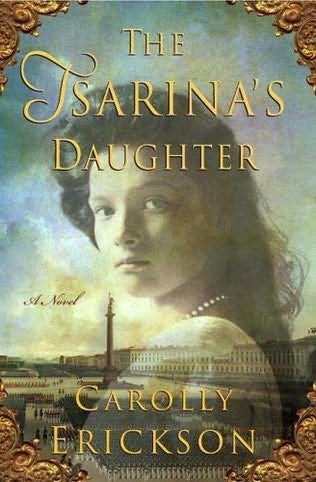
The Tsarina's Daughter ~ Carolly Erickson

It is 1989 and Daria Gradov is an elderly grandmother living in the rural West. What neighbours and even her children don't know, however, is that she is not who she claims to be - the widow of a Russian immigrant of modest means. In actuality she began her life as the Grand Duchess Tatiana.

This is the story of Tatiana (Tania) Romanov, the second daughter to Tsar Nicholas II and Tsarina Alexandra. Tania and her sisters and brother life a life of luxury in pre-revolutionary Russia in the Winter Palace in St. Petersburg. When little Alexei is born with "the English disease" (hemophilia) the family turns to the illiterate monk Rasputin as the key for his survival. Soon war breaks out and revolution sweeps across the country sending the family into imprisonment if far away Siberia. 

☆☆☆

The Tsarina's Daughter was a hard book for me to give a typical rating to. Normally I don't have any trouble deciding where it should land on my rating scale, however this one proved to be difficult, therefore I have decided to give it two sets of ratings. As a story, I give it 4 stars; the story itself was imaginative, and very well written. The characters were well developed, though unbelievable. However as a historical fiction, I give it 1 1/2 stars; where was the history? The idea that Tatiana Romanov was able to escape from the palace on multiple occasions, had two lovers before the age of 18, and to escape certain death and married a common soldier ... all highly unlikely to occur. I think that a lot of people, myself included, thinking that when a book is marketed as a historical fiction that we expect there to be some liberties taken with the characters - conversations and small events. However, when there are details in these novels (such as the daughter of the Tsar having two lovers while in her teens, one of these relationships being condoned by her aunt) it almost ruins the integrity of being called a historical fiction.

While I love imagining "what might have been" in regards to the demise of the Romanov family, even this story seemed a little too far fetched to believe. I am a fan of Erickson as both a historian and as a writer however I was greatly disappointed with this novel - it is definitely not one of her best works. I would caution those who are interested in reading this book - if you are a purist, definitely do not read this novel, it will only drive you crazy pointed out all of the historical inaccuracies and portrayal of the Imperial family. However, if you are looking for an interesting read, a "what if..." story and aren't too particular about the inaccuracies, then this is a decent read.

3.04.2012

On this day . . .

March 4th 1461

Wars of the Roses in England:

Lancastrian King Henry VI is deposed by his Yorkist cousin, who then becomes King Edward IV  

Roses-Lancaster victory.svg

3.03.2012

Bride of New France ~ Suzanne Desrochers

Taken from her parents as a young child and presumed to be an orphan, Laure Beausejour has grown up in a dormitory in Paris surrounded by prostitutes, the insane and other forgotten women. She has grand dreams of using her needlework skills to become a seamstress and to one day marry a nobleman. These dreams however will remain just that, as Laure is sent across the ocean to New France as a fille du roi. Laure knows nothing of her new home except for stories of ferocious winters and equally ferocious Indians who, legend has it, eat the hearts of French priests and scalp French women. Laure must learn to adapt to her new life in Ville-Marie (modern day Montréal) where she is expected to marry and produce many children while her husband abandons her for the harsh winter to live with the Algonquians as a courrier du bois. Bride of New France explores many of the challenges that a young fille du roi must face upon her arrival in her new home.
☆☆
I was stoked to finally read this story and I have to say that I was beyond disappointed. A lot of the time I found myself questioning why certain things were included . . . for example there were some characters thoughts randomly in the middle of the page and I had no idea why they were there or who was thinking them and really, what was the point of having them there. Prime example – what was with Deskaheh cutting her? What was the point of that and why was that not explained if it was an important detail? And if it wasn’t important what was it doing in the story? The story was dull, there was no climax and it was predictable.

The first half of the book wasn’t bad – Laure’s life in the dormitory in Paris and the voyage across the ocean – these parts were interesting but once she arrives in Ville-Marie the story takes a turn for the worst . . .  the story became so boring and tedious and I just could not wait to be finished. I feel like Desrochers missed an amazing opportunity to really dive into the life of a fille du roi and really explore the challenges and struggles of these girls. The latter half of the book felt like the author was getting tired of writing this story. I really disliked Laure once she arrived in New France – in Paris she is adventurous and determined to make something of herself but once she arrives in Ville-Marie she seems to be defeated and as if she is just an empty shell simply enduring life in New France. She does not grow as a character but rather digresses; I would have loved for her to accomplish something and persevere through the challenges of her new world rather than just suffer and passively watch her life pass by. I also found her to be very selfish and she was extremely snobby and stuck-up even though she came from nothing and has nothing other than her needlework skills which are of no use to her in New France.

This book could have been so much more and I think that is one of the main reasons why I was so disappointed in it, along with the one-dimensional characters and strange thoughts/conversations. To be honest, I really wouldn’t recommend this book. 

2.27.2012

The Lady of the Rivers ~ Philippa Gregory


This is the third book in the Cousin’s War series and it focuses on Jacquetta, Duchess of Bedford and mother of the future Queen of England. Descended from Melusina, the river goddess, Jacquetta has always had the gift of second sight. Growing up in France, visiting her uncle, she meets his prisoner, Joan of Arc and recognizes her own power in the young woman accused of witchcraft. Jacquetta is soon married to the Duke of Bedford, English regent of France, and it is her husband who first introduces her to the dangerous and mysterious world of alchemy and who asks her to use her gifts to the benefit of England. Her only friend in the Duke’s household is a squire, Richard Woodville, who is at her side when the Duke’s death leaves her a wealthy young, beautiful widow. The two become lovers and marry in secret and return to England to serve in the court of the young King Henry VI and his French Queen Margaret of Anjou, to whom Jacquetta becomes a close and loyal friend. Henry the king slides into a mysterious sleep; Margaret the queen turns to untrustworthy favourites for help; and Richard, Duke of York threatens to overturn the whole kingdom for his rival dynasty of the House of York. Jacquetta fights for her King, her Queen, and for her daughter Elizabeth Woodville, a young woman married to a neighbour for whom Jacquetta can sense an extraordinary and unexpected future: a change of fortune, the throne of England, and the white rose of York.

☆☆☆☆

If you are going to read this series, I would suggest starting with this book rather than with the White Queen as this book ends where the White Queen begins. It also provides a lot of background information about the War of the Roses and the lives of Henry VI and Margaret of Anjou. There are references to both of the previous novels in this book and a lot of scenes were repeated from the Red Queen.

The novel started out a little slow for me but it picked up about ¼ of the way in. I really enjoyed the character of Jacquetta and her “sight”. I also really enjoyed the romance between Jacquetta and Sir Richard Woodville – it was genuine and very well written. Even though they were both forced apart while serving their King and Queen, their marriage remained strong and fruitful – it was nice to see that for once true love could prevail against the odds.

I was not too impressed with the portrayal of Margaret of Anjou – she seemed like a spoiled little girl who pouts when she doesn’t get her own way. Margaret falls into the category of French Queens coming to England and things going downhill from there for the country. Every time Margaret opened her mouth I cringed because I felt like I was dealing with an annoying teenager, even in her later years. She was incredibly annoying and utterly stubborn. Maybe if she had not been so set on revenge and blinded by love with the Duke of Somerset, and if she had actually listened to those around her, maybe there would not have been so many problems in her life and the lives of her country. She also has a seemingly psychotic son, who may or may not be a legitimate heir to the throne.

Poor Jacquetta is trapped right in the middle of the War of the Roses, the war that tore England apart – she is good friends with the Red Queen, Margaret of Anjou and mother of the White Queen, Elizabeth Woodville. Jacquetta however plays her role perfectly, as she switches loyalties with ease. 

There were also a lot of miss opportunities for some major drama – the Duke of Gloucester and his ambitious wife Eleanor is a prime example of a pair who never reached their dramatic potential.

Overall I would say that this was a decent novel, not one of Gregory’s best works but still not bad. Again, I would definitely recommend reading this novel first in the series followed by The White Queen as that novel picks up where this one leaves off. 


2.12.2012

The Red Queen ~ Philippa Gregory

Two royal houses, each thinking that they are the rightful heir to the throne can only mean one thing: War. The Red Queen is the second novel in the Cousins’ War series (the first being The White Queen) and it tells the story of Margaret Beaufort, heiress to the red rose of the House of Lancaster. Being only a girl, Margaret is of no use to her family, except to carry a royal son, so she is married off to Edmund Tudor, half-brother to the King and twice her age. She is sent off to live with her new husband in Wales – alone, widowed and afraid she is left to deal with a difficult labour which nearly kills her but delivers the House of Lancaster its long awaited heir, a son named Henry. Margaret is quickly married off to another kinsman, Henry Stafford, son of the Duke of Buckingham and is forced to leave her son behind with his uncle Jasper in Wales. Margaret is determined to take her destiny into her own hands and to place her son on the throne of England, as it is God’s will. Throughout the ever changing political times, Margaret feigns alliance to the Yorkist Kings (Edward IV and Richard III) and plots to have her son crowned King of England and has him betrothed to the Princess Elizabeth, daughter of the House of York in a plot to united England. 


☆☆☆


I love Philippa Gregory’s novels. While this was not one of her best novels, I have to say that it still kept my interest and I still ended up really enjoying the story, despite my dislike of Margaret Beaufort. I get the impression that she wasn’t well liked in life either. I have to say that even though I was not a fan of Margaret in her younger years – common now, a young girl who is convinced that she was the English Joan of Arc based on a few tales she heard from travelling soldiers and actually hoping to hear voices from God as Joan (supposedly) did, but I grew to like her in her adult years. The pious, meek young girl grew into malicious, callous woman with a wicked tongue – some of the best lines in the book came from this woman. I also really enjoyed Margaret’s third husband Sir Thomas Stanley – he was just as shrewd and cynical as Margaret was – and it was his character that really propelled the novel in the latter chapters. I found it very improbable that Margaret and the other characters would repeatedly exchange letters filled with details about their treasonous thoughts, schemes and beliefs as they do in the novel – they might as well have simply asked for their heads to be removed from the rest of their bodies.  

Once again Gregory was able to bring to life another set of historical figures in a way that not many others can. The writing style, the details, the characters, the gripping battle scenes . . . Even though this is part of a series, it could just as easily stand on its own. Gregory once again weaves her magic around the existing historical facts and creates yet another fantastic work of fiction. Overall I found this to be a very enjoyable read about the woman who bound the Houses of Lancaster and York together and who founded the Tudor dynasty. I would recommend this novel to Gregory fans as well as any lover of historical fiction. 

Madame Tussaud ~ Michelle Moran


Marie Grosholtz is a smart, ambitious young wax sculptor who will one day become the famous Madame Tussaud. Mademoiselle Grosholtz works alongside her uncle in their celebrated wax museum, the Salon de Cire, which houses her popular model of the American ambassador Thomas Jefferson, a tableau of the royal family at dinner and a model of Madame du Barry amongst others – Marie’s museum provides Parisians with the very latest news on fashion, gossip and politics. Upon a visit from the royal family, the King’s sister requests Marie’s presence at Versailles as a royal tutor in wax sculpting – an offer that Marie knows that she cannot refuse. Set in a time of unrest and revolution and through the Reign of Terror, Moran brings to life the reality of revolution and the woman who through her talents, saved her own life and preserved the faces of a vanished kingdom.

☆☆☆☆

I am a huge fan of Michelle Moran’s work. I fell in love with her writing style and storytelling with “Nefertiti” and again with “The Heretic Queen”. When I found out that she was leaving the ancient world and moving to not-so ancient history I went through a small panic – would this book be as good as the others? Will she be able to write about a different time and place with such ease? The answer to both questions was thankfully a resounding “yes!” I have a soft spot for anything about the French Revolution – I love that period in France and the craziness that surrounds it. Moran is able to carefully tread the bloody path from revolution to Reign of Terror without losing the reader and explaining the rapidly changing and complicated politics. Moran also brings to life the Salon de Cire and the wax figures and people who called it home. Once again, Moran excels at writing – adding details about the setting, the fashions, the atmosphere, etc., without it taking away from the story at hand.

One of the few complaints that I have about this novel was the portrayal of Marie – she is portrayed as being cold, unemotional and concerned only about her career and making money. Although there is someone who is deeply in love with her and who wants to marry her, Marie wants nothing of it and uses her career and her shop as an excuse – even when times are desperate she still chooses her shop over love. Although I commend her for sticking with her career and not giving in to the traditions of her time, I still find this hard to believe to be exactly what happened given the time period. I also feel like the ending was rushed – the novel itself covered a span of five years throughout the revolution and Reign of Terror, but the latter years of Marie’s life were crammed into a few pages. This leads me to my final problem with this novel: the title. I think that it was a bit misleading naming the novel Madame Tussaud: A Novel of the French Revolution considering the title character did not become Madame Tussaud until the end of the story. I don't think that the book needed the pull of the name "Madame Tussaud", I believe that it would have done just as well with a different name. While I loved reading about her life during the revolution, I would have also liked to have read about her life in London . . . a potential sequel maybe? Overall it was a fantastic book about the French Revolution and I would definitely recommend it! 

2.06.2012

At the Mercy of the Queen ~ Anne Clinard Barnhill


At the Mercy of the Queen tells the time-old tale of Anne Boleyn however the story is told through the eyes of young Madge Shelton, cousin to the Queen. Madge arrives at court at the tender age of 15 to serve as her cousin Queen Anne’s lady-in-waiting. Madge quickly becomes the confidante of the Queen and is privy to her innermost thoughts, feelings and secrets.

Anne is desperate to hold on to the love of her King and Madge is determined to help her does just that. Anne schemes to have Henry take her naive young cousin as mistress, guaranteeing her husband’s new paramour will owe her loyalty to the queen. Madge however has fallen in love with a handsome young courtier, Arthur Brandon, the illegitimate son of Charles Brandon, Duke of Suffolk. Not only must Madge win over the king’s affections to help her cousin but she must also fend off the unwanted attention of Sir Henry Norris.

☆☆½

For a debut novel, this wasn’t half bad. I have to say that even though I love the Tudor era and all of the wives of Henry VIII, I have grown tired of the same stories over and over again – this however was a new and refreshing view of life at the court of Henry VIII and Anne Boleyn.  

The characters were well developed and there were solid historical facts, however the dialogue was a bit distracting at times – the transitions between modern English and old English were not smooth and the French . . . oh the French – you cannot mix old French with modern French and if you are going to write in French, please make sure that you are using the right genders and accords! (Maybe it’s because I’m a French teacher, but this is something that drives me crazy with these English authors trying to write in French, please do not rely on Google Translate and such).

I also have to say that I was disappointed in the ending. It was a little predictable and it kind of felt like the author got tired of writing and just really did not know how to end the story.